Artistic Collaboration in the Age of the Divine Feminine Uprising / Collective

As the divine feminine collective gathers more steam in mainstream conversation, two feminine artists were collaborating quietly on a tricky topic: representation. When Natalie Devora reached out to Teresa (Tess) Njeri Mugo to commission a painting on representation of albinism in art, little did Natalie know what to expect. All she did was to give the brief to Tess and give the painter free reign to work on the artwork as she saw fit.
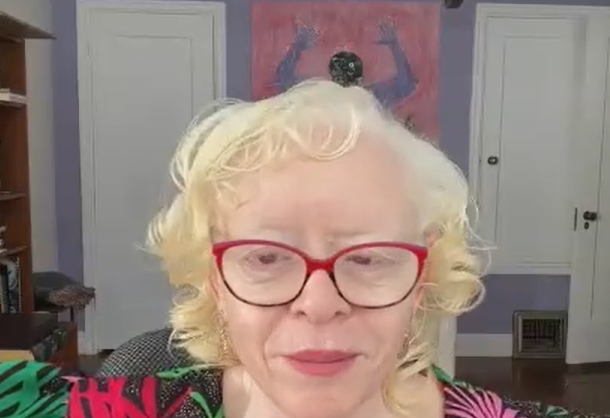
Natalie’s vision was tied in with the International Albinism Awareness Day’s theme for the year: “proudly in my skin, celebrating all skin tones.”
To have that vision represented by Tess in the finished painting was something that took even Natalie by surprise, and Natalie, as an artist herself, is generous with praise.
A Black woman with albinism, she has spent the better part of her life learning to occupy space in a world that cannot quite decide what to do with her: too light for some rooms, too dark for others, always conspicuous, always required to explain herself before she has even spoken. Art, for Natalie, was never a luxury. It was the first language in which she recognized herself.
Tess arrived through the long road of research, the kind of deep, unhurried study that belongs to women who believe that understanding something is an act of love. She came to the collaboration not just as a painter but as a woman who has spent years as a student of art, of astrology, of mythology, and something she cares deeply about – universal sisterhood. She understood that representation is not merely a political act. It is, at its root, a metaphysical one. To be painted is to be declared real.
The work they made together refuses to be merely decorative or a piece of vanity. It is capturing the essence of Natalie’s “bravery, fierceness, personality” and Natalie’s lived experience as a Black woman with albinism.
In Tess’s art, Natalie's personality is not just represented, it is rendered with precision as seen through the eyes of someone who is not afraid to see the world for what it is. There is a difference, and it matters enormously. To exoticize is to keep a subject at arm's length, to marvel from behind glass. To render is to press close, to give full weight, to say: this person's interiority is as complex and worthy of representation as anyone else's. The feminine collective has always known this. Sisterhood, at its most essential, is the refusal to make your sister a footnote in her own story.

Representation in art is sometimes discussed as though it is primarily about optics. But this is authenticity as a collaborative practice rather than a solo performance. It is the belief that the truest version of a story often requires more than one voice to hold it steady.
What Natalie and Tess have done with this painting is older and more urgent than just representation for the sake of it.
They are doing what women through the ages have always done when they gathered: they are encoding memory. They are saying, with pigment and intention, we were here, and we were whole, and we were luminous, and we were never what they said we were.
The artwork that has emerged from their collaboration carries this weight without being burdened by it. It is empowered art – not in the exhausted, overclaimed way that that word is sometimes used, but in the original sense: it gives power back to the vision, and its representation as imagined by a collaborator living half a world away. To Natalie, who sees herself reflected with full dignity. To every woman with albinism who will encounter these images and feel, perhaps for the first time, the particular relief of being imagined correctly. To Tess, who pours herself into the work, immersing herself in a story that can only be told through paint and canvas.
As the next part to this series on feminine artistic collaboration, Natalie will feature snippets from her interview with Tess, and the camaraderie that illuminated their exchange. This three-part series will conclude with an article featuring Natalie’s experience from commissioning the artwork to receiving it, as also the painting itself.
Watch this space.
********
Teresa Njeri Mugo is an artist and painter based in Nairobi, Kenya, and the creative force behind Tessellate Studio. She works primarily with acrylics on canvas, creating unique, deeply personal painting pieces made for the spaces people live and work in. Every piece she makes is intentional, crafted to fit not just a wall, but the story of the person it belongs to. Whether for a home or an office, her work is designed to do more than just decorate; it's made to provoke feeling, spark conversation, and hold its own in any room.
Tessellate Studio believes art should have a presence - something with character, weight, and a point of view. That's the spirit behind everything they create and it's exactly what their motto captures: “Hang something that argues back.”
Part 2 in this series: Proudly in My Skin
Part 3 in this series: Becoming Oneself